
Busy Doesn’t Always Mean Productive
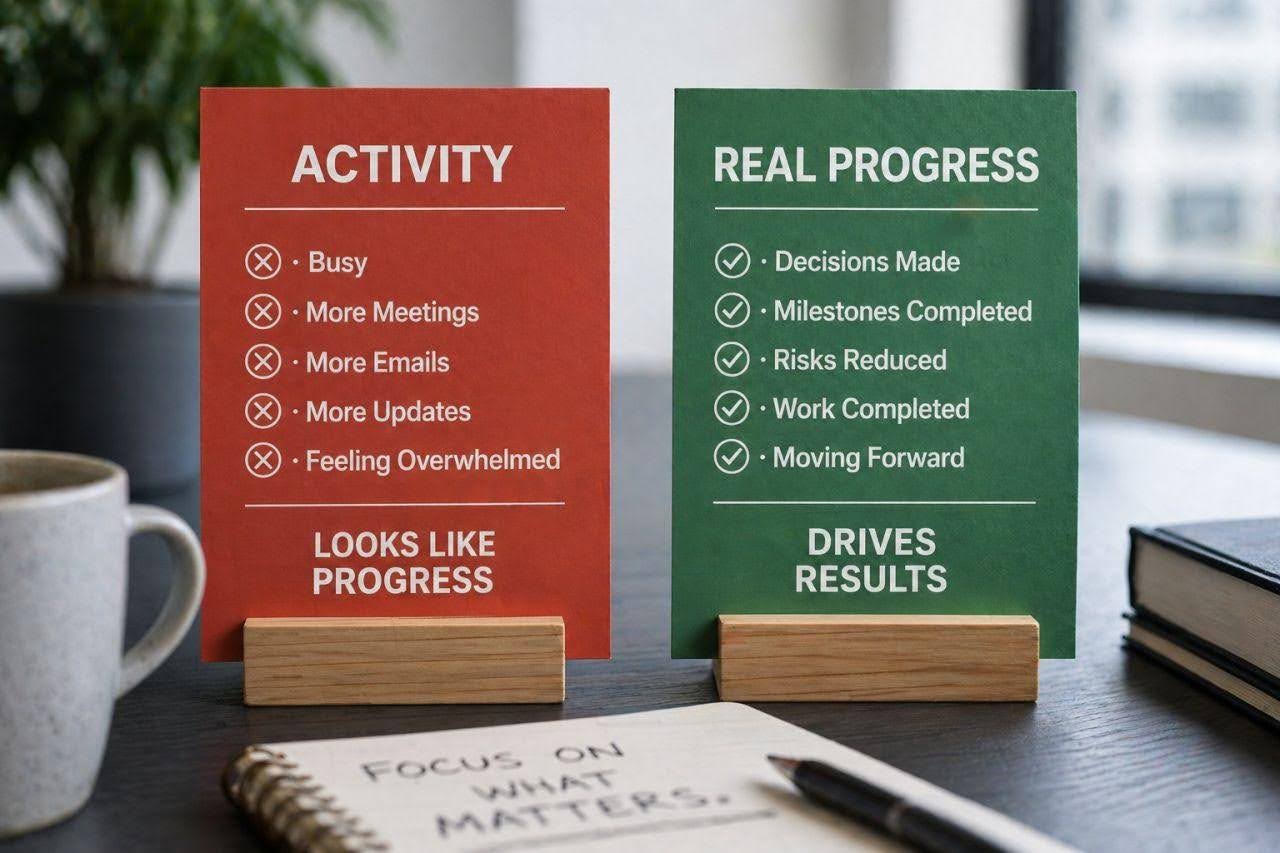
Modern project environments are filled with activity. Calendars are packed with meetings, inboxes are constantly active, status updates are circulating throughout the day, and teams are often managing dozens of priorities simultaneously. From the outside, this level of motion can appear to represent strong execution and momentum. However, activity and progress are not the same thing, and confusing the two is one of the most common reasons projects begin to lose focus.
In complex manufacturing, engineering, and CQV environments, teams can work extremely hard while making surprisingly little meaningful progress. Meetings take place continuously, tasks remain in progress for extended periods, and communication channels remain highly active, yet critical milestones continue slipping. The challenge is not a lack of effort. In most cases, the teams involved are highly committed and deeply engaged. The issue is that effort becomes disconnected from the work that actually advances the project.
Activity often looks impressive because it creates visible motion. There are more meetings, more updates, more coordination discussions, and more parallel tasks being managed at once. Many of these activities are necessary to support execution, but they do not automatically create forward movement. Projects succeed when decisions are made, milestones are completed, risks are reduced, and important work is fully finished rather than continuously circulated between teams.
One of the primary reasons organizations become trapped in activity is the increasing complexity of modern projects. As more stakeholders become involved, communication requirements expand. Additional meetings are scheduled, reporting expectations increase, and approval processes become more layered. Over time, teams can unintentionally shift from advancing the project to managing the appearance of project management itself. Everyone feels busy, so everyone assumes progress is occurring, even while critical decisions remain unresolved and major deliverables continue stalling.
Excessive work in progress is another major contributor to this problem. Many teams attempt to advance too many priorities simultaneously, creating constant context switching and fragmented execution. Deliverables remain partially completed across multiple areas of the project, which generates more coordination, more follow-up discussions, and more status tracking. While this may feel productive in the moment, partially completed work often creates more friction than momentum. Strong execution teams recognize that completed work drives progress, while excessive unfinished work creates operational noise.
Meetings are perhaps the clearest example of activity being mistaken for progress. When projects encounter challenges, organizations often respond by increasing communication frequency. Additional meetings are intended to improve alignment and accountability, but more meetings do not necessarily solve execution problems. In many cases, excessive meetings slow decision-making, interrupt focused work, reduce ownership, and create fatigue across the organization.
Effective project meetings serve a specific purpose. They help teams make decisions, remove blockers, clarify ownership, reduce risk, or accelerate execution. When meetings repeatedly fail to accomplish those objectives, they become another form of activity that consumes time without meaningfully improving outcomes.
One of the defining characteristics of high-performing teams is clarity around priorities. Strong project leaders consistently ask which activities truly move the project forward, which decisions are blocking execution, and which risks deserve the most immediate attention. They understand that execution quality often improves when teams focus on fewer priorities, complete work before starting new tasks, and eliminate unnecessary complexity.
This requires discipline because “doing more” often feels productive. However, successful execution is rarely driven by the volume of activity taking place. More often, it is driven by focus, prioritization, and the ability to make timely decisions. Projects frequently slow down not because teams lack capability, but because unresolved decisions create bottlenecks that ripple throughout the organization. In those situations, activity increases around the unresolved issue through additional meetings, escalations, and discussions, while the project itself remains stalled.
High-performing execution teams are not necessarily less busy than others, but they are far more intentional about how they spend their time and energy. They focus on completing critical work, resolving constraints early, driving accountability, and protecting the time necessary for meaningful execution. Most importantly, they continually ask an important question throughout the life of a project: “Are we simply active, or are we actually making progress?”
That distinction has a profound impact on project outcomes. Projects rarely fail because people did not work hard enough. Most teams are already working extremely hard. Projects struggle when effort becomes disconnected from execution and when activity begins replacing measurable progress. Busy calendars do not complete milestones, long meetings do not eliminate risk, and constant updates do not substitute for ownership and decision-making.
Progress occurs when the right work gets completed at the right time. Although that principle sounds simple, maintaining that focus in complex projects is often one of the most difficult and valuable disciplines an organization can develop.
#Project Execution
#Projects Stalling
# Resource Constraints