
Robotic Medical Devices Are Advancing, but Submission Readiness Will Decide What Moves Forward
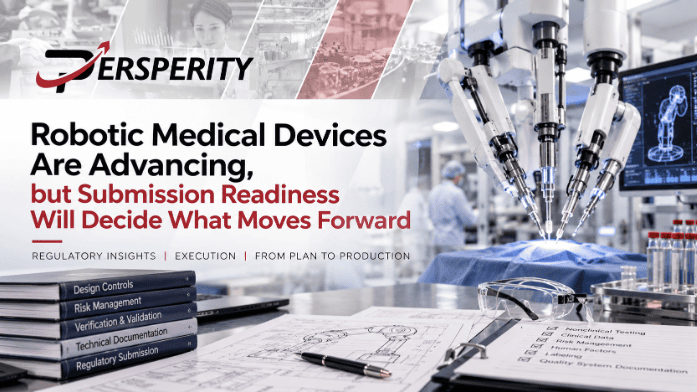
Robotic medical devices are getting more regulatory attention, and that should matter to every team working in medical devices, digital health, quality systems, validation, technical writing, and regulated product development.
FDA’s Center for Devices and Radiological Health recently highlighted several robotic medical device updates, including a draft guidance on Robotically-Assisted Surgical Devices: Premarket Submissions, a public workshop on benefit-risk evaluation for robotic medical devices with autonomous or remote teleoperation capabilities, and broader robotic medical device engagement opportunities. U.S. Food and Drug Administration
That is important because robotic medical devices sit at the intersection of hardware, software, human factors, clinical use, cybersecurity, labeling, training, risk management, and quality systems. The technology may look futuristic, but the execution work is very practical.
For medical device manufacturers, the question is not only, “Can the robot perform the task?”
The better question is, “Can the team prove the device is safe, effective, controlled, documented, and ready for review?”
FDA Is Signaling More Focus on Robotic Device Readiness
FDA’s draft guidance for robotically-assisted surgical devices is intended to provide recommendations on nonclinical testing, clinical data, and labeling to support premarket submissions for certain robotically-assisted surgical devices. FDA describes these devices as teleoperated, software-controlled systems that integrate robotic technologies and subassemblies to help qualified practitioners position and control surgical instruments during procedures. U.S. Food and Drug Administration
That description matters because these products are not simple devices.
They involve mechanical performance, software behavior, user interaction, clinical workflow, operating environment, training needs, failure modes, and procedure-specific risks. A submission package has to bring all of that together in a way that is organized, evidence-based, and review-ready.
FDA also opened the draft guidance for comments through November 24, 2026, which gives industry an opportunity to respond before the agency works toward a final version. U.S. Food and Drug Administration
For manufacturers, this is a good time to pressure-test whether internal project teams are building submission readiness early enough, instead of trying to assemble the story late in development.
Robotic Devices Need More Than Engineering Confidence
Engineering confidence is important, but it is not the same thing as regulatory readiness.
A robotic medical device team may have strong design work, strong software development, and strong clinical promise, but still struggle if the documentation, testing strategy, labeling rationale, risk controls, and quality records are not aligned.
FDA’s robotic device page notes that robotic medical devices can be used across settings such as surgery, diagnosis, and rehabilitation, and that devices with autonomous or remote teleoperation capabilities have the potential to further transform patient care. U.S. Food and Drug Administration
That potential creates a larger execution challenge.
Teams need to connect product development, design controls, software validation, human factors, clinical evidence, risk management, cybersecurity, supplier management, usability, labeling, training, and post-market considerations. If those workstreams move separately, the project can look busy while readiness gaps build in the background.
The device may work in a controlled demonstration.
The submission may still not be ready.
Benefit-Risk Conversations Are Becoming More Complex
FDA’s upcoming public workshop on December 2 and 3, 2026 will focus on benefit-risk evaluation for robotic medical devices with autonomous or remote teleoperation capabilities. FDA says the workshop is intended to deepen understanding of user experience, foster dialogue around benefits and risks, and explore future policy considerations while maintaining safety and effectiveness. U.S. Food and Drug Administration
That is a signal for manufacturers.
As devices become more autonomous, connected, software-driven, or remotely operated, benefit-risk thinking has to become more structured. Teams need clear evidence of what the device does, how users interact with it, what happens when something goes wrong, how performance is monitored, and how changes will be managed.
This is where project execution becomes essential.
The right questions need to be answered early:
Is the intended use clearly defined?
Are device functions and user roles documented?
Are nonclinical and clinical evidence needs aligned?
Are software and hardware requirements traceable?
Are risks, mitigations, and residual risks clearly justified?
Are labeling and training materials supported by evidence?
Are change controls and quality records ready for review?
These questions are not just regulatory details. They determine whether innovation can move through development, submission, and eventual commercialization with confidence.
Documentation Is Part of the Product Story
For complex medical devices, documentation is not paperwork after the real work.
It is how the real work becomes reviewable.
A strong robotic medical device submission needs a clear story that connects design decisions, testing, risk controls, clinical use, user needs, labeling, and quality system evidence. If the submission package is disorganized, incomplete, or inconsistent, strong technical work can still become difficult to review.
FDA’s September 25 public meeting on regulatory science innovations was designed to gather stakeholder perspectives on emerging device technologies and identify regulatory science gaps that could affect development of novel and disruptive medical devices over the next decade. U.S. Food and Drug Administration
That reinforces the same point: innovation is moving, and the support systems around innovation need to mature too.
For manufacturers, that means technical writing, project controls, documentation management, review cadence, cross-functional alignment, and submission planning should not be treated as late-stage tasks.
They are part of readiness.
The Persperity Perspective
Robotic medical devices show where regulated product development is heading: more advanced technology, more software, more human interaction, more data, and more complex evidence needs.
That makes execution more important, not less.
Persperity supports complex projects in life sciences, pharmaceutical manufacturing, biotech, medical devices, CQV, C&V, project controls, validation, startup readiness, technical writing, and regulated manufacturing.
For medical device programs, that means helping teams organize workstreams, strengthen documentation, coordinate reviews, support readiness planning, track open actions, align quality expectations, and keep projects moving toward submission and commercialization.
Robotic medical devices may represent the future of care, but the path forward still depends on disciplined execution.
Persperity helps teams move complex projects from plan to production by making sure the work behind the innovation is clear, controlled, documented, and ready for what comes next.
Tags: Autonomous Medical Devices, Benefit-Risk Assessment, Clinical Evidence, Design Controls, FDA Premarket Submissions, Human Factors, Medical Device Documentation, Medical Device Innovation, Quality Systems, Regulatory Readiness, Risk Management, Robotic Medical Devices, Robotic Surgery, Software Validation, Submission Readiness, Technical Writing, Teleoperation