
Plasmid DNA Supply Is Becoming the New Readiness Test for Cell and Gene Therapy
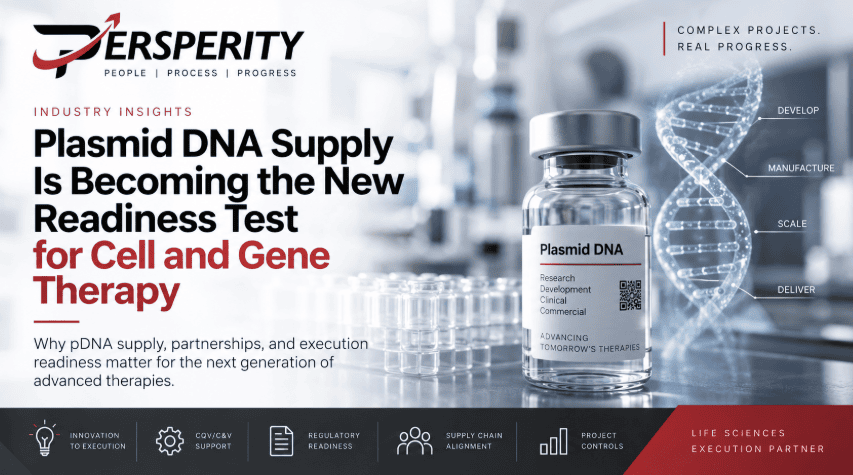
Cell and gene therapy developers are moving quickly, but one of the most important execution issues is not always the therapy itself. It is whether the critical materials, documentation, testing, technology transfer, and manufacturing systems are ready to support the program as it advances.
A timely example came on September 9, when Bionova Scientific and Minaris announced a strategic partnership to expand access to high-quality plasmid DNA for advanced therapy development and manufacturing. The companies said the partnership is designed to support reliable, scalable pDNA supply across the product lifecycle, simplify supply chain management, streamline technology transfer, and accelerate the path from research to commercial manufacturing. (Minaris)
That matters because plasmid DNA is a critical input for many cell and gene therapy workflows, including AAV and lentiviral vector manufacturing. If pDNA supply is late, inconsistent, difficult to scale, or poorly integrated into the broader manufacturing plan, the entire program can feel the impact.
pDNA Is Moving Into the Execution Spotlight
For advanced therapy teams, plasmid DNA cannot be treated like a routine material order.
It affects process development, vector production, analytical testing, quality review, comparability, tech transfer, GMP readiness, and ultimately the ability to move a therapy toward patients. In the Bionova and Minaris partnership, the companies specifically pointed to pDNA requirements for AAV and lentiviral vector manufacturing workflows, combining Minaris’ OXGENE plasmid technologies with Bionova’s pDNA development and manufacturing capabilities. (Minaris)
That type of partnership reflects where the industry is heading.
Cell and gene therapy development is becoming more dependent on integrated manufacturing ecosystems. Sponsors need specialized partners, but they also need those partners to connect cleanly with the rest of the program. A strong technical capability is not enough if the handoffs, timelines, documentation, quality expectations, and manufacturing assumptions are unclear.
Standardization Can Help, But It Does Not Remove Control
One notable detail from the announcement is that the companies are establishing a portfolio of 13 production-ready plasmids built on SnapFast technology. The portfolio includes nine AAV plasmids across Rep/Cap serotypes 1 through 8 plus adenoviral helper functions, along with four lentiviral vector plasmids. Manufacturing is already underway, with two plasmids supporting an active customer program, research-use materials expected in about four weeks, and remaining releases planned in phases. (Minaris)
That kind of standardization can reduce friction.
It can give developers faster access to materials, make planning easier, and help teams move earlier from research toward scalable workflows. But standardization does not eliminate the need for control.
Teams still need to confirm intended use, documentation requirements, quality expectations, analytical needs, change control, release criteria, storage conditions, vendor responsibilities, and how materials will be managed as the program moves from research use toward clinical or commercial GMP manufacturing.
A standardized input still has to fit into a controlled process.
Advanced Therapy Manufacturing Is Becoming More Operational
The timing also fits the broader industry conversation. The 11th CAR-TCR Summit, taking place September 15 to 17 in Boston, is focused on cell therapy development from innovation through commercial success, including automated manufacturing integration and commercial impact. The event agenda includes an Automated Manufacturing, Regulations and Partnering Bootcamp, with sessions focused on reducing cost of goods, strengthening commercial scale readiness, and aligning with GMP expectations. (11th CAR-TCR Summit 2026)
The Cell & Gene Meeting on the Mesa in October is also expected to focus on commercialization, manufacturing, CMC challenges, clinical development, scale-up, and supply chain platforms for advanced therapies. (Cell & Gene Meeting on the Mesa)
The message is clear: the industry is no longer only talking about scientific promise. It is talking about how advanced therapies actually get made, transferred, scaled, controlled, and delivered.
That shift matters for pharmaceutical, biotech, and medical device manufacturers because the same execution pattern shows up across regulated environments. Innovation creates the opportunity, but readiness determines whether the opportunity moves.
What Teams Should Pressure-Test Early
For CGT teams, pDNA supply should be part of the readiness conversation early, not treated as a background procurement item.
Teams should pressure-test several practical areas:
Is the pDNA strategy aligned with the vector manufacturing plan?
Are supplier roles, timelines, and quality expectations clearly documented?
Are research-use, clinical, and GMP material transitions understood?
Are analytical requirements and release expectations clear?
Are tech transfer requirements visible before the program reaches a bottleneck?
Are changes to plasmid design, sequence, supplier, process, or scale being controlled?
Are project controls tracking material readiness, vendor dependencies, documentation, and open risks?
These questions are not administrative details. They determine whether teams can keep momentum as complexity increases.
The Persperity Perspective
Plasmid DNA supply is a useful example of a larger truth in life sciences: complex projects do not succeed because one technical piece works. They succeed when the technical pieces, quality systems, documentation, vendors, validation activities, project controls, and operational readiness all move together.
Persperity supports complex projects in life sciences, pharmaceutical manufacturing, biotech, medical devices, CQV, C&V, project controls, validation, startup readiness, and regulated manufacturing.
For advanced therapy and manufacturing programs, that means helping teams organize workstreams, align stakeholders, strengthen documentation, track readiness, coordinate vendors, support validation planning, and keep execution moving.
Cell and gene therapy may be driven by scientific innovation, but the path to patients depends on practical execution.
Persperity helps teams move complex projects from plan to production by making sure the work behind the science is structured, visible, and ready to move.
Tags: AAV, Advanced Therapies, C&V, CGT, CMC, CMC Readiness, CQV, Cell and Gene Therapy, Documentation, GMP Readiness, Lentiviral Vector, Manufacturing Readiness, Plasmid DNA, Project Controls, Quality Systems, Supply Chain Readiness, Tech Transfer, Technology Transfer, Validation, Vector Manufacturing, Vendor Readiness, pDNA