
The Phrases That Quietly Derail Projects
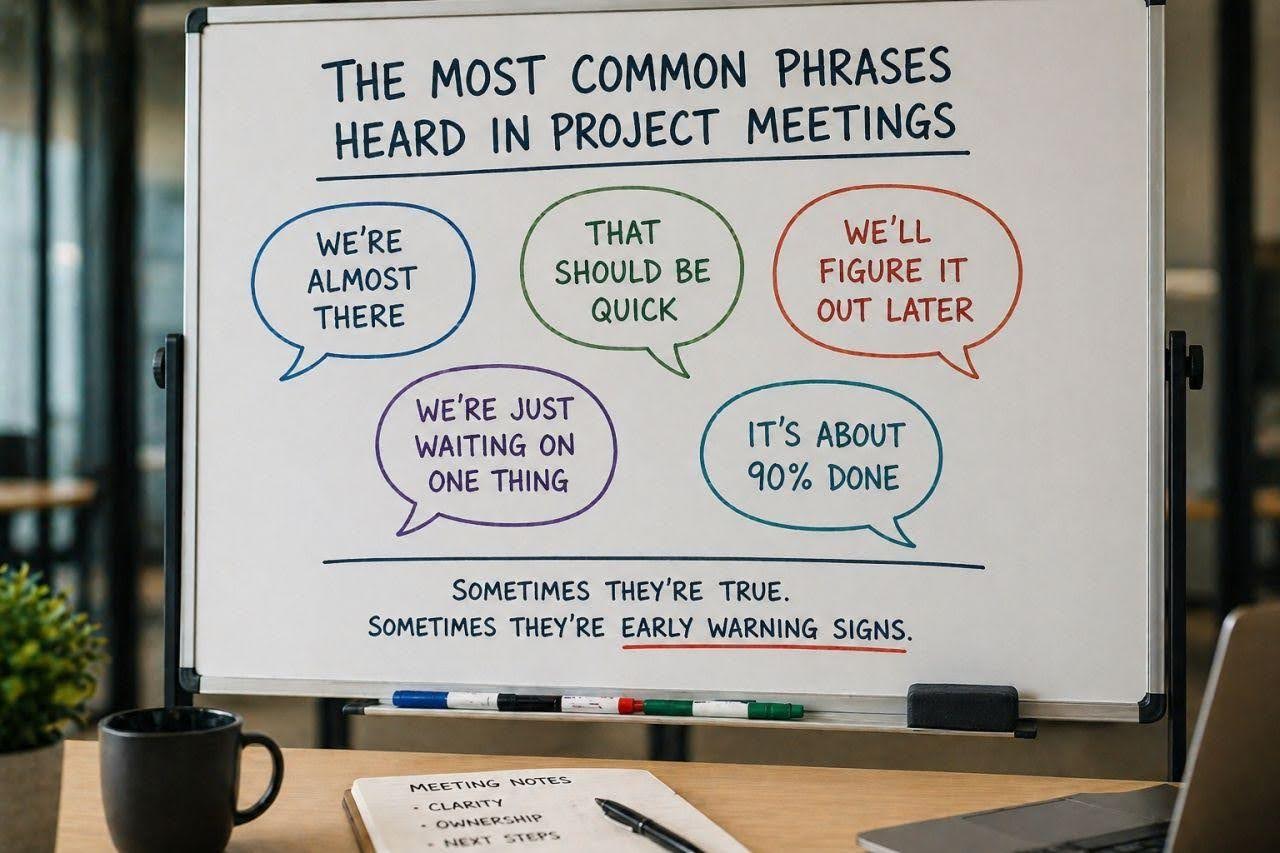
Walk into enough project meetings and the same phrases begin to surface repeatedly. They are familiar statements that appear in manufacturing expansions, engineering projects, CQV initiatives, automation integrations, and leadership reviews across nearly every industry. Phrases such as “We’re almost there,” “That should be quick,” or “We’ll figure it out later” are often used casually and without bad intent. In many cases, they are spoken by capable, experienced professionals who are attempting to maintain momentum and optimism within a project environment.
The problem is not necessarily the phrases themselves, but what they often represent. In complex projects, vague optimism can unintentionally replace clarity, and when clarity disappears, risk begins to grow. Teams may believe they are aligned while operating under completely different assumptions regarding priorities, timelines, responsibilities, or definitions of completion. Over time, those gaps compound and begin to affect execution.
One of the most common examples is the phrase, “We’re almost there.” While the statement sounds encouraging, it rarely communicates meaningful information by itself. Does it mean that deliverables are complete? Has testing been finalized? Are punch-list items closed? Have operational teams reviewed the system under real-world conditions? In many manufacturing and CQV environments, projects often feel closest to completion precisely when the most difficult work is beginning. The final stages of a project frequently involve cross-functional coordination, troubleshooting, documentation reconciliation, operational readiness activities, and regulatory review. These efforts are rarely linear and often contain the highest concentration of execution risk.
Similarly, project leaders often hear the phrase, “That should be quick.” Experienced teams learn to pay close attention whenever this language appears because complexity tends to hide within seemingly simple tasks. A minor design adjustment may trigger document revisions, change controls, validation impacts, procurement delays, or additional approvals. What initially appears straightforward can become significantly more complicated once dependencies are fully understood. Strong execution teams do not automatically assume every task is difficult, but they do take time to ask thoughtful questions regarding downstream impacts, required reviews, and potential obstacles before committing to timelines.
Another common phrase is, “We’ll figure it out later.” In some situations, deferring decisions is appropriate and necessary. Not every detail must be solved immediately. However, unresolved decisions often accumulate quietly until they create substantial problems later in the project lifecycle. Delayed clarity can lead to ownership gaps, conflicting assumptions, compressed schedules, and bottlenecks near startup or implementation. The closer a project moves toward execution, the more expensive ambiguity becomes. Effective project teams understand which decisions can reasonably wait and which unresolved issues are likely to create future disruption.
Teams also frequently describe projects as “just waiting on one thing.” In reality, complex projects are rarely dependent on a single isolated issue. Most manufacturing and engineering efforts involve interconnected systems, suppliers, approvals, operational constraints, and cross-functional dependencies. What appears to be one outstanding item is often tied to multiple downstream activities and hidden risks. Experienced project leaders therefore spend significant time identifying critical paths and uncovering constraints that may not be immediately visible.
The larger issue underlying all of these phrases is the false sense of alignment they can create. Everyone in the meeting may feel informed and optimistic, while key details remain unclear beneath the surface. Different teams may have different definitions of completion, unresolved risks may not be openly discussed, and ownership of critical actions may remain ambiguous. Projects rarely fail because of a single catastrophic event. More often, they drift off course because small assumptions go unchallenged for too long.
High-performing project teams distinguish themselves not by pessimism, but by precision. Instead of relying on broad statements about progress, they ask direct questions regarding remaining deliverables, ownership, unresolved risks, and realistic timelines. Rather than assuming something will be quick, they evaluate dependencies and downstream impacts. This level of rigor is not unnecessary bureaucracy; it is an essential form of risk management.
One of the biggest misconceptions in project leadership is that optimism alone builds confidence. In reality, teams build trust through clarity. They trust leaders who communicate openly about risks, define ownership clearly, surface concerns early, and align teams around reality rather than assumptions. Particularly in complex manufacturing and CQV environments, precision is not optional. It is often the difference between smooth execution and costly delays.
Ultimately, most projects do not struggle because teams lack intelligence, experience, or effort. They struggle because ambiguity quietly accumulates over time. The language used in project meetings matters more than many organizations realize. Sometimes the most valuable thing a project leader can do is pause a discussion and ask a simple question: “Can we define exactly what that means?” That moment of clarification often prevents problems that would otherwise emerge much later, when the cost of correction is far greater.
#Project Execution
#Projects Stalling