
As Pharma Leans on CDMOs, Tech Transfer Readiness Becomes the Real Risk
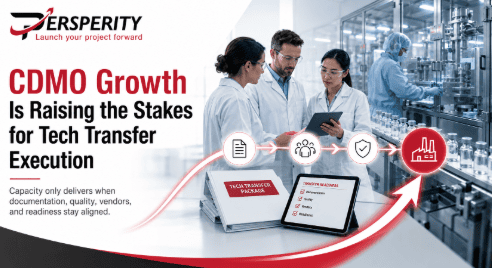
Pharmaceutical companies are continuing to rely on external manufacturing partners, but the bigger issue is no longer whether a CDMO has capacity.
The bigger issue is whether the sponsor and CDMO can transfer the work, align quality expectations, validate the process, control documentation, and move toward commercial supply without creating gaps that show up later in deviations, delays, audits, or supply risk.
That issue came into focus recently when Aurigene Pharmaceutical Services, a subsidiary of Dr. Reddy’s Laboratories, announced a long-term manufacturing and supply agreement with a global pharmaceutical company. The agreement covers more than 20 drug products across sterile injectables, biologics, and topicals for markets including the U.S., Europe, Canada, and emerging regions. The portfolio will be manufactured across Aurigene facilities in India. (Express Pharma)
The most important detail is not only the size of the portfolio. It is the execution model. Reporting on the agreement described a phased technology transfer program over the next two to three years, which means the work will depend on sustained coordination across product, process, quality, documentation, validation, equipment, automation, vendors, and commercial supply planning. (ETPharma.com)
Tech Transfer Is Where Strategy Becomes Work
A CDMO agreement may begin with business strategy, but technology transfer is where the project becomes operational.
That transfer has to convert process knowledge, development history, analytical expectations, batch records, quality requirements, equipment needs, facility readiness, vendor data, and regulatory commitments into a working manufacturing program.
For sterile injectables, biologics, and topicals, the complexity is not identical across product types. Sterile manufacturing brings contamination control, aseptic process expectations, environmental controls, and strict procedural discipline. Biologics bring process sensitivity, analytical complexity, and scale-up considerations. Topicals bring their own formulation, process, packaging, and quality control needs.
Managing all of that across more than 20 products is not just a manufacturing challenge.
It is a project execution challenge.
The Risk Is Not Just Delay
Many organizations think about tech transfer risk in terms of schedule delays. That is part of it, but the risk is broader.
A transfer can look active while still being weak.
Meetings are happening.
Documents are moving.
Equipment is being discussed.
Timelines are being updated.
Teams are busy.
But if ownership is unclear, the project may still be exposed.
Common issues include incomplete document packages, mismatched templates, late vendor deliverables, unclear quality agreement language, undefined validation responsibilities, inconsistent change control expectations, missing data requirements, and unresolved assumptions about equipment or automation readiness.
These are the details that can create rework later.
In a regulated environment, tech transfer is not successful because information was shared. It is successful when the receiving site can execute the process in a controlled, documented, inspection-ready way.
CDMO Growth Raises the Bar for Project Controls
The broader market context also points in the same direction. The White House recently announced that nine pharmaceutical manufacturers committed to invest at least $19.6 billion collectively in U.S. manufacturing in the near term as part of new drug pricing agreements. The announcement also tied the commitments to pharmaceutical supply chains and reserves. (The White House)
Whether manufacturing is being expanded internally, shifted geographically, or supported through CDMO partnerships, the same operational truth applies: capacity only matters when the work can be qualified, documented, validated, staffed, and sustained.
That is where project controls become important.
Strong project controls should give leadership visibility into what is complete, what is late, what is waiting on a decision, what is at risk, and who owns the next step. In a tech transfer environment, that visibility needs to cover more than the schedule. It needs to cover documentation status, validation readiness, quality approvals, vendor dependencies, equipment readiness, materials, training, change controls, deviations, open actions, and handoffs between teams.
Without that structure, leaders may not see the real risk until the timeline has already slipped.
What Sponsors Should Pressure-Test Early
For sponsors working with CDMOs, the most important work happens before the transfer becomes chaotic.
Teams should pressure-test several areas early:
Are the transfer plan and governance model clear?
Are process descriptions, batch records, methods, specifications, and historical data complete enough to support transfer?
Are quality agreements and approval pathways aligned?
Are validation responsibilities divided clearly between sponsor, CDMO, vendors, and internal teams?
Are equipment, utilities, automation, cleaning, and facility requirements understood?
Are vendor documents and data packages being tracked?
Are change control and deviation expectations aligned?
Are project controls showing real readiness, not just activity?
These questions are practical. They are also strategic. A sponsor can select a strong CDMO and still struggle if the transfer is not managed with enough discipline.
Tech transfer needs structure, cadence, ownership, and follow-through.
The Persperity Perspective
CDMO partnerships can help life sciences companies increase flexibility, access specialized capabilities, and support commercial supply. But the value of those partnerships depends on execution.
Persperity supports complex projects in life sciences, pharmaceutical manufacturing, biotech, medical devices, CQV, C&V, project controls, validation, startup readiness, and regulated manufacturing.
For tech transfer programs, that means helping teams organize the work, align stakeholders, track critical path activities, strengthen documentation, support validation planning, manage open actions, coordinate vendors, and keep the project moving toward readiness.
Persperity is not positioned as a firm that only provides recommendations from the outside. The value is hands-on execution support inside complex projects, where the work has to move from plan to production.
As pharma leans more heavily on CDMOs and manufacturing networks become more complex, tech transfer readiness will become a bigger differentiator.
Because the real risk is not signing the agreement.
The real risk is assuming the transfer will take care of itself.