
Sterile Injectable Manufacturing Is Expanding, but Capacity Alone Will Not Deliver Results
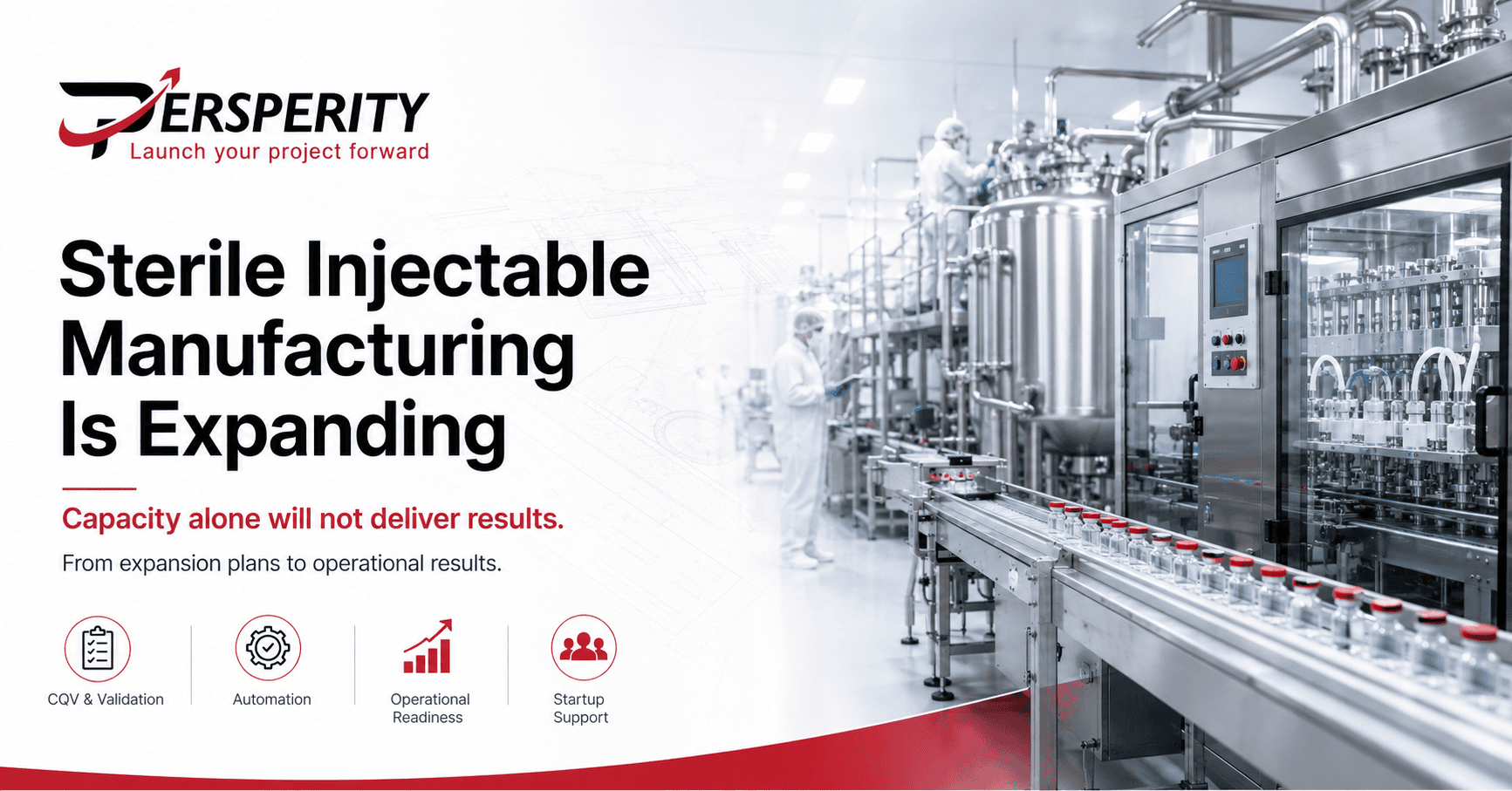
Sterile injectable manufacturing is becoming one of the clearest signals of where life sciences investment is headed. Demand for injectable therapies, biologics, advanced medicines, and complex drug products is creating pressure for more domestic capacity, more flexible fill-finish operations, stronger packaging networks, and better startup execution.
Recent industry activity shows that sterile manufacturing is not just growing. It is becoming more strategically important. Resilience recently announced the relocation of its corporate headquarters to Blue Ash, Ohio while expanding sterile injectable manufacturing capabilities near its West Chester facility. The company described the move as part of a highly integrated regional hub for sterile manufacturing, device assembly, packaging, and supply chain operations.
That type of investment is not only a real estate or facilities story. It is an execution story.
For pharmaceutical, biotech, and medical device manufacturers, sterile capacity only becomes valuable when facilities, equipment, utilities, automation, documentation, quality systems, trained operators, and startup processes are ready to perform together. The industry can build more sites, add more fill-finish lines, and expand packaging capability, but the real business value comes when those assets are qualified, validated, staffed, documented, and operating reliably.
The Capacity Expansion Pressure Is Real
Sterile injectable capacity is under pressure because the products are complex and the market is moving quickly. Industry research projects the sterile injectables CDMO market will grow from $6.65 billion in 2025 to $7.36 billion in 2026, with continued growth projected through 2030. That growth is being driven by demand for biologics, cell and gene therapies, aseptic processing capabilities, and outsourced sterile manufacturing support.
The recent Resilience announcement is one example of how companies are responding. Its Ohio hub is intended to connect sterile manufacturing, device assembly, packaging, and supply chain operations in one regional footprint. That matters because sterile products often depend on tightly coordinated work across multiple functions and physical locations.
At the same time, major pharmaceutical manufacturers are also investing heavily in new U.S. manufacturing capacity. Eli Lilly’s planned $6.5 billion Houston-area manufacturing campus is expected to include facilities for small molecule medicines and oligonucleotides, with construction activity beginning in 2026 and completion targeted by 2030. These kinds of large capital programs show how much companies are betting on manufacturing infrastructure to support future pipelines.
Sterile Manufacturing Is a Coordination Challenge
Sterile manufacturing is unforgiving because the margin for error is small. Facilities must be designed and maintained to support contamination control. Clean utilities must be available and reliable. Process equipment must be installed correctly. Automation and data systems must support controlled operations. Environmental controls must be monitored. Procedures must be clear. Operators must be trained. Quality approvals must happen at the right time.
That means the biggest risks are often not isolated to one workstream. A delay in vendor documentation can affect qualification. A change in automation can affect validation. A late training package can affect startup readiness. An incomplete turnover package can slow commissioning. A quality review delay can push the schedule even if the equipment itself is installed.
This is why sterile capacity expansion requires more than project coordination. It requires integrated execution.
Teams need visibility into dependencies before they become schedule problems. They need clear ownership across engineering, vendors, automation, quality, validation, operations, and project controls. They need documentation that reflects the current state of the project, not last month’s assumptions. They need readiness planning that begins before startup pressure is already high.
CQV, C&V, and Documentation Become Business-Critical
In sterile manufacturing expansion, CQV and C&V are not administrative steps at the end of a project. They are part of how manufacturing readiness is built.
Commissioning, qualification, verification, and validation activities help confirm that systems are installed correctly, operate as intended, and support the required manufacturing process. For sterile environments, this can include utilities, equipment, automation, environmental monitoring, process controls, cleaning processes, aseptic operations, and supporting documentation.
Documentation also becomes a business-critical control. User requirements, vendor documents, test protocols, deviation records, turnover packages, traceability matrices, training records, and approval workflows all help teams prove readiness. If those records are unclear, late, incomplete, or disconnected from actual field conditions, the project can look ready on a dashboard while still carrying serious startup risk.
Good documentation is not just paperwork.
It is how teams maintain alignment, prove decisions, transfer knowledge, support inspections, and move from construction or installation into controlled operations.
Project Controls Must Protect the Outcome
As sterile manufacturing investments grow, project controls need to do more than report schedule status. They need to help teams see risk early.
A useful dashboard is not the one that simply shows green until the week of startup. A useful dashboard helps teams understand whether vendor packages are complete, testing is progressing, quality reviews are moving, automation issues are closing, training is on track, and operational handoff is realistic.
In capital projects, leaders often ask, “Are we on schedule?”
A better question is, “Are the right workstreams ready to support the next milestone?”
That shift matters. It turns project controls from reporting into decision support. It helps leaders understand where intervention is needed before delays become visible to everyone.
The Persperity Perspective
Sterile manufacturing expansion is good news for the life sciences industry, but expansion plans do not automatically become operational capacity.
The real value is created in execution.
That is where Persperity fits. Persperity supports complex projects in regulated manufacturing environments by helping teams move from plan to production. That includes the practical work that often determines whether a project gains momentum or stalls: project execution, CQV/C&V support, documentation, vendor coordination, readiness planning, quality alignment, project controls, and startup support.
Persperity is not positioned as a firm that only provides recommendations and leaves clients with a deck. The company’s value is hands-on support, embedded execution, and helping teams close the gaps that slow down scale-up.
As sterile injectable manufacturing continues to expand, manufacturers will need more than new facilities and equipment. They will need disciplined execution across every workstream that turns capacity into reliable production.
That is the difference between building capacity and delivering it.