
Paperless Validation Is Not a Software Project
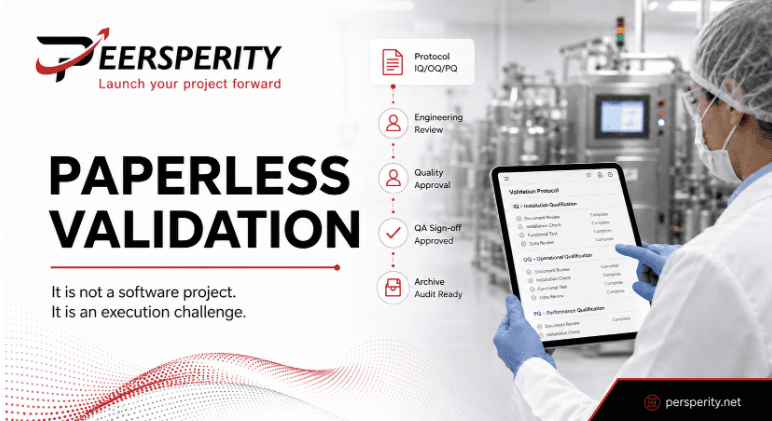
Digital validation is becoming a major priority across life sciences, but the mistake many teams make is treating it like a software installation.
It is not.
Paperless validation is an operating-model change. It touches CQV, C&V, validation, quality, documentation, approvals, audit readiness, training, project controls, system ownership, and the way teams execute regulated work every day.
The pressure is real. Kneat’s 2026 State of Validation reporting describes validation workload as being at a five-year high, with digital adoption accelerating and AI becoming part of the validation conversation. The report is based on more than 600 validation professionals across six continents, which gives it useful context for where the industry is heading.
That trend matters because life sciences companies are already under pressure to expand capacity, launch faster, reduce rework, improve inspection readiness, and maintain data integrity. Digital validation can help, but only when the transition is executed with discipline.
The challenge is not the platform.
The challenge is how the organization changes the way validation work gets planned, performed, reviewed, approved, and sustained.
Digital Validation Is Moving From Experimentation to Execution
For years, paperless validation was often discussed as a future-state improvement. Today, it is becoming a practical necessity for many life sciences organizations.
Validation teams are handling more work, more systems, more documentation, and more pressure to move quickly without compromising compliance. Kneat’s 2026 validation content points to record workload pressure, growing digital maturity, and the expectation that AI will become more common in validation environments over the next several years.
That does not mean every company is ready.
Going digital requires more than uploading protocols into a platform. It requires clear process ownership, strong configuration decisions, harmonized templates, trained users, workflow design, role clarity, inspection-ready records, and change control.
If those elements are not addressed early, digital validation can create a new kind of complexity.
Instead of paper binders, teams end up with unclear workflows, inconsistent execution, bottlenecked approvals, poorly defined responsibilities, and users who are unsure where the official record lives.
Digital tools can improve the work.
They do not automatically fix the work.
Compliance Still Depends on Intended Use and Risk
FDA’s 2026 Computer Software Assurance guidance reinforces a risk-based approach for software used in medical device production or quality management systems. The guidance is focused on establishing confidence in automation, identifying where additional rigor is appropriate, and applying testing activities based on risk.
That principle matters beyond medical devices because it reflects a broader reality in regulated environments: technology has to be fit for intended use.
For paperless validation, teams need to understand how the system will be used, what records it controls, what workflows it supports, what approvals it manages, and where it may affect product quality, patient safety, data integrity, or compliance.
FDA’s Part 11 guidance also emphasizes that validation decisions should consider the system’s impact on predicate rule requirements and the accuracy, reliability, integrity, availability, and authenticity of required records and signatures. It recommends basing the approach on a justified and documented risk assessment.
That is why digital validation cannot be treated as a simple IT deployment.
It is a regulated process change.
The Real Risk Is Poor Change Management
The hardest part of paperless validation is often not the technology. It is the transition.
Teams may need to migrate templates, redesign workflows, align approval paths, train users, define system roles, update procedures, validate the platform, retire legacy processes, and keep active project work moving at the same time.
That is a lot to manage.
If the transition is not structured well, teams may experience delayed approvals, duplicate work, document confusion, inconsistent execution, or resistance from users who are already busy.
This is where project execution becomes critical.
A strong paperless validation transition should answer practical questions early:
Who owns the process?
Which validation activities move first?
Which templates need to be standardized?
How will legacy documents be handled?
How will users be trained?
How will approvals flow?
How will data integrity be maintained?
How will quality review timelines be protected?
How will active CQV and C&V work continue without disruption?
These questions are not theoretical. They determine whether digital validation improves execution or slows it down.
Paperless Validation Needs Cross-Functional Alignment
Paperless validation touches many groups.
Validation needs efficient execution. Quality needs confidence and compliance. Engineering needs usable workflows. Operations needs clear handoff. IT needs system control. Project leaders need visibility. Vendors may need to provide documentation in ways that support digital execution.
If those groups are not aligned, the system may go live, but the process may not work.
That is why cross-functional planning matters.
Digital validation should support real project delivery. It should make it easier to execute protocols, review evidence, close comments, track status, manage approvals, support audits, and reduce avoidable rework. It should give leaders better visibility into what is complete, what is waiting, what is at risk, and what needs a decision.
When done well, paperless validation strengthens project controls.
When done poorly, it becomes another system people work around.
The Persperity Perspective
Paperless validation is not just a technology trend.
It is an execution challenge.
Life sciences teams need digital tools, but they also need the structure, ownership, readiness planning, documentation discipline, and cross-functional alignment to make those tools work in regulated environments.
That is where Persperity fits.
Persperity supports complex projects in life sciences, pharmaceutical manufacturing, biotech, medical devices, CQV, C&V, project controls, validation, startup readiness, and regulated manufacturing. We help teams move through the practical work that turns strategy into results.
For paperless validation, that means helping organizations think beyond software and focus on implementation, readiness, documentation, quality alignment, training, workflow ownership, and project execution.
Because digital validation does not succeed when the platform goes live.
It succeeds when the work keeps moving, the records are reliable, and the team is ready to execute with confidence.